
Reviewed · KATHMANDU UNESCO WORLD HERITAGE TOURS
UNESCO Five World Heritage Tour in Kathmandu
Kathmandu’s sacred heart is packed into one demanding day: hilltop Swayambhunath, old royal courtyards, Patan’s carved temples, Pashupatinath’s Hindu shrine complex, and Boudhanath’s great Buddhist stupa. This private tour gives you a driver, guide, and car, so you spend your energy looking rather than bargaining for taxis.
I like the private format, which lets you ask questions and adjust the pace. I also like that entry fees and hotel transfers are included, useful when several sites are spread across the city. The drawback is simple: this is a lot of culture in 7 to 8 hours, and some stops receive only a few minutes.
Key points to know before booking
- Sixteen listed stops: The route includes major UNESCO sites plus individual temples, courtyards, towers, and museums.
- Private car and guide: Only your group takes part, with a 9:00 am start.
- Strong guide feedback: Shanti, Sarita, Tej, and Rabina are named in the supplied comments, with Shanti praised often for clear explanations and flexibility.
- Best for first-time visitors: You cover Kathmandu, Patan, and the two major religious centers in one day.
- Included value: Heritage entry fees, transport, professional guiding, and hotel pickup and drop-off inside the Ring Road are covered.
- Bring time and attention: The schedule moves quickly, with some important sites getting only 5 to 15 minutes.
Why this one-day route works in Kathmandu
Kathmandu Valley can feel confusing at first. Temples sit beside traffic-clogged streets, Buddhist prayer wheels turn near Hindu shrines, and grand royal squares are mixed with ordinary shops and homes. This tour gives that busy setting a clear shape.
You begin at Swayambhunath, move through Kathmandu Durbar Square, continue to Patan, then finish at Pashupatinath and Boudhanath. That order takes you through the valley’s main artistic and religious traditions without asking you to arrange several separate taxi rides.
The tour is private, not a shared group outing. That matters here. You can ask why a temple is important, pause over a carving, or request a little more time at a favorite stop. Several guides named in the supplied comments, including Shanti, Sarita, Tej, and Rabina, are described as clear, flexible, and easy to spend a long day with. Shanti receives especially frequent praise for her explanations and calm handling of the schedule.
At $130 per person, the value depends on your group size. For one person, it is a costly sightseeing day. For two or more people, the private car, driver, guide, and included admissions make the price easier to justify. Food and drinks are not included, so plan to pay for those separately.
More UNESCO heritage sites in Kathmandu:
- Private Kathmandu Sightseeing Tour | UNESCO World Heritage sites
★ 5.0 · 756 reviews - Kathmandu: Full Day 7 UNESCO Tour with Lunch – Private/Group
★ 5.0 · 415 reviews - Kathmandu: Full Day Top 4 UNESCO Tour with Lunch – Private/Group
★ 5.0 · 269 reviews
Swayambhunath and the hilltop view
Your first major stop is Swayambhunath, often called the Monkey Temple. The supplied schedule allows about an hour, which gives you time to take in the stupa and the surrounding religious setting.
This is one of the most useful places to begin because it introduces the blend of Hindu and Buddhist practice that shapes Kathmandu. The stupa is important to Buddhist and Hindu communities alike. Your guide can help explain what you are seeing instead of leaving you to sort out the symbols on your own.
Nearby, the Amideva Buddha Park gets about 15 minutes. Three large statues of Shakyamuni Buddha make this a short but pleasant stop near the hill. It is not a second major monument on the scale of Swayambhunath, but it gives you a quieter pause and another view of Buddhist imagery.
The first hour sets the tone for the day. You will see sacred places, but this is not a museum-style tour where every object is isolated behind glass. Religion remains part of daily life here. That makes a good guide especially useful, since the meaning of a shrine may not be clear from its architecture alone.
Kathmandu Durbar Square, where the details pile up
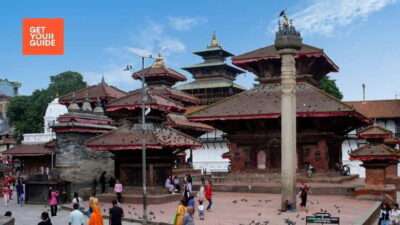
Kathmandu Durbar Square is the first major royal courtyard on the route. The visit is listed at about an hour, followed by shorter stops at Basantapur Tower, Degu Taleju Temple, Kumari Chowk, and Kaal Bhairab.
The square gathers temples, palace buildings, courtyards, and carved architectural details in a compact area. Some structures are still being rebuilt, so do not expect every building to appear untouched. Reconstruction is part of the present-day view, not a reason to skip the square.
Basantapur Tower receives 30 minutes. It is one of the attractive points within the square and gives the palace area a stronger sense of scale. Degu Taleju Temple gets about 10 minutes. Built in 1564, it adds a specific date and royal connection to the visit.
At Kumari Chowk, you see the courtyard linked with Nepal’s living goddess tradition. A girl is selected as Kumari and remains in that role until puberty. A visit to the courtyard does not guarantee that you will see the Kumari, but one person on this tour was lucky enough to do so. Treat that as a fortunate possibility, not part of the promise.
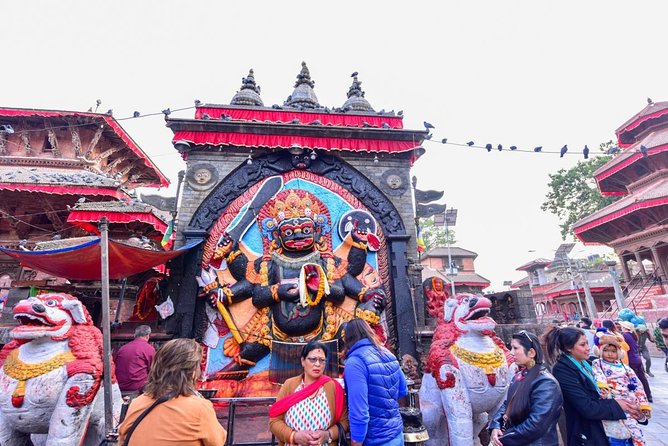
Kaal Bhairab is a quick five-minute stop. The statue represents Bhairav, a fierce form associated with Shiva. Five minutes may sound brief, but this is the kind of stop where a clear explanation helps more than a long wander. Your guide can give you the essential context, then keep the day moving.
This section is a good example of the tour’s main tradeoff. You see a lot, but you rarely have unlimited time. If you like detailed photography or want to study every carving, the pace may feel brisk.
Patan’s Newar art and royal courtyards
Patan, also known as Lalitpur, is the artistic centerpiece of the day. The route allows about an hour at the Patan Royal Palace area and another 45 minutes at Patan Durbar Square, with short visits to individual temples and Patan Museum.
Patan is especially useful for understanding Newar architecture. The Newar community shaped much of the valley’s temple design, wood carving, metalwork, and courtyard planning. Look for the relationship between the palace spaces and the temples around them, rather than treating each building as a separate photo stop.
Taleju Mandir gets about 15 minutes. It was rebuilt by Srinivasa Malla after a fire in 1676. That detail shows how much of Kathmandu Valley’s architecture has been shaped by damage, rebuilding, and continued use.
Patan Museum is scheduled for 15 minutes. Inside, you can see old statues, carved windows, and wooden pillars. Fifteen minutes is enough for a quick look, but not a full museum visit. If you care most about art and religious sculpture, you may want to tell your guide early that the museum matters to you.
The Golden Temple, or Hiranya Varna Mahavihar, is another short stop of about 10 minutes. This 12th-century pagoda-style temple is known for bronze statues and silver and gold decoration. It is a compact site, but the decorative work rewards close attention.
Vishwanath Mandir Temple receives five minutes. Built during the reign of Siddhi Narsingh Malla, it is dedicated to Shiva. Bhimsen Temple gets 15 minutes and is worshiped by the Newar community as the god of business and trade. Together, these small stops show that Patan’s religious life is not limited to one grand monument.
If you could choose only one place for a slower visit, Patan would make a strong case. The route gives you a useful introduction, but the combination of royal buildings, temple courtyards, and museum objects deserves more time than a packed day can provide.
Same city, a completely different sort of day:
- Everest Base Camp Trek – 14 Days
★ 5.0 · 1,499 reviews - Everest Base Camp Helicopter Tour landing at Everest View Hotel
★ 5.0 · 668 reviews - Half day cooking class in Thamel kathmandu
★ 5.0 · 607 reviews - Everest Base Camp Trekking
★ 5.0 · 485 reviews
Pashupatinath, Kathmandu’s major Hindu center
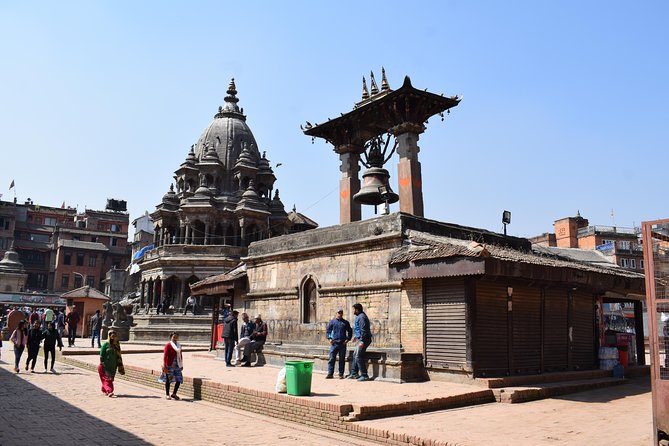
Pashupatinath receives about an hour. This Hindu temple complex contains more than 500 shrines and temples and is the main temple center for devotees of Shiva.
You should understand one practical point before arriving: the central temple is a Hindu shrine, so access rules apply. The complex itself offers plenty to see, including pagoda structures and numerous smaller religious buildings, but your guide will help explain what you can view and how to behave respectfully.
This is one of the places where cultural context matters most. Pashupatinath is not just an old building to photograph. It is an active religious complex. Keep your voice low, follow local instructions, and avoid treating worship as a performance for visitors.
The one-hour stop is long enough to make the site meaningful, though the day’s schedule still leaves little room for a slow, reflective visit. If you are strongly interested in Hindu practice, this may be one of the points where a private tour earns its keep. You can ask direct questions and have your guide explain the difference between the main temple, surrounding shrines, and the wider complex.
Boudhanath, a strong finish beneath prayer flags
The final listed stop is Boudhanath Stupa, with about an hour. This large Buddhist monument is described as 36 meters high and surrounded by prayer wheels and images connected with the Buddha.
Boudhanath gives the day a different mood from Pashupatinath. The broad dome, circular form, and Buddhist details create a clear visual contrast with the Hindu temple complex you have just visited. It is also a good place to review the day’s central theme: Kathmandu is shaped by both Hindu and Buddhist traditions, often in close proximity.
Use your hour to look carefully at the stupa’s form and the surrounding religious details. Your guide can explain the purpose of the prayer wheels and the meaning of the imagery. The site works well at the end because you have already seen royal architecture, Newar craftsmanship, Hindu temples, and Buddhist monuments.
The final stop also gives the route a satisfying geographic and cultural range. You begin on a hill at Swayambhunath, pass through the old royal centers, and finish at one of the valley’s major Buddhist sites.
The pace, transport, and daily practicalities
Pickup begins at 9:00 am. Hotel pickup and drop-off are included within Kathmandu’s Ring Road area, including the Bouddha area. If you stay outside that zone, the supplied details do not promise transfers, so confirm the arrangement before booking.
Transport is by private car. That removes the need to bargain with taxi drivers between sites and makes the day easier to manage. It also gives you a private space between stops, though the tour still depends on a full day of city sightseeing.
The formal duration is about 7 to 8 hours. With 16 listed stops, that is a full schedule. The main sites receive roughly 45 to 60 minutes, while several temples get only 5, 10, or 15 minutes. You should think of this as a broad introduction, not a slow architectural study.
Wear clothing suitable for religious sites and expect to walk around courtyards and temple areas. The supplied information does not provide a detailed accessibility statement, so ask the operator if you have mobility concerns. Most people can take part, but the route includes religious complexes and historic areas where surfaces and access may vary.
Your admission fees are included, which is helpful because the day contains several separate heritage stops. Food and drinks are not included. Pack or purchase refreshments according to your needs, but do not expect meals to be part of the $130 price.
Free cancellation is available if you cancel at least 24 hours before the start time. Changes or cancellations inside that window are not refunded.
Who will get the most from this tour
I would choose this tour if you have limited time in Kathmandu and want a structured first look at the valley’s major cultural sites. It is particularly useful for solo visitors and couples who would otherwise spend much of the day arranging transport.
It also suits you if you want historical and religious explanations, not just transportation. The strongest guide comments describe detailed teaching, clear answers, and a friendly manner. Sarita is singled out for her grasp of Nepali history, while Shanti is repeatedly praised for information, patience, and flexibility. Tej and Rabina are also named as guides who helped make the experience informative and well organized.
I would be more cautious if you dislike busy schedules or want extended time at each temple. The route covers a great deal, but the short stops can feel like a sample platter. You may leave with a strong map of Kathmandu’s culture and a list of places you would like to revisit, rather than a complete look at every site.
Should you book the UNESCO Five World Heritage Tour?
Book it if you want the efficient version of Kathmandu: one private car, one guide, included admissions, and the valley’s major sacred and royal sites in one day. The best reasons are the route’s range and the chance to ask questions as you move from Buddhist stupas to Hindu temples and Newar palace courtyards.
Skip it if you want a slow museum day, long photography sessions, or a relaxed visit to only one or two monuments. At $130 per person, the tour is easiest to justify when you value private transport and expert explanation, or when you are sharing the cost with another person.
For a first day in Kathmandu, I think the plan is strong. Just arrive ready for a full schedule, make Patan or Pashupatinath your priority if one matters most, and tell your guide where you want a little extra time.
FAQ
What is included in the tour price?
The price includes private-car transport, entry fees for the heritage sites, a professional tour guide, and hotel pickup and drop-off inside the Ring Road area, including Bouddha.
What time does the tour start?
The stated start time is 9:00 am.
How long does the tour last?
The tour lasts approximately 7 to 8 hours.
Is this a private tour?
Yes. Only your group takes part in the activity.
Are food and drinks included?
No. Food and drinks are not included in the tour price.
Can I cancel for a full refund?
Yes, if you cancel at least 24 hours before the experience start time. Cancellations made less than 24 hours before the start time are not refunded.
Just added around Kathmandu
- Traditional Momo Making Class★ 5.0 · 10 reviews
- Wildlife Adventure in Chitwan Nepal★ 4.0 · 4 reviews
- Walking tour of real Kathmandu through back streets.★ 5.0 · 3 reviews
- Kathmandu 2 Nights 3 Days Chitwan Jungle Safari Tour★ 5.0 · 9 reviews
- Kathmandu Street Food Walking Tour – Eat Like a Local★ 5.0 · 3 reviews
- Private Manaslu Circuit Trek at Himalayas★ 5.0 · 3 reviews
- Walking tour of Kathmandu with awesome local guides★ 5.0 · 4 reviews
- Visit Swayambhunath and Bauddhanath Stupa with Guide★ 5.0 · 5 reviews
Kathmandu UNESCO World Heritage Tours, compared.
Private Kathmandu Sightseeing Tour | UNESCO World Heritage sites
Read our review →
Full Day 7 UNESCO Tour with Lunch – Private/Group
Read our review →
Full Day Top 4 UNESCO Tour with Lunch – Private/Group
Read our review →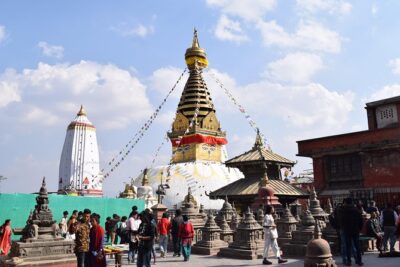
Browse the lists this tour appears in