
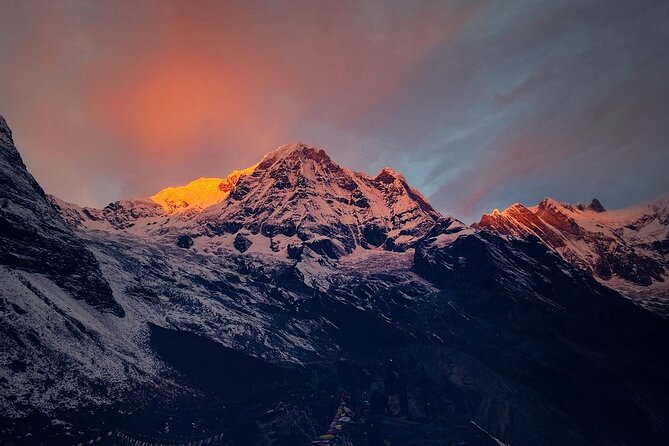
Reviewed · ANNAPURNA TREKS FROM KATHMANDU
Annapurna Circuit Trek with Tilicho Lake
The big draw here is the full Annapurna Circuit with Tilicho Lake, not a quick mountain sampler. Over 16 days, you move from river valleys and pine forest to dry high country, a 5,416-meter pass, a famous alpine lake, hot springs, and a sunrise walk on Poon Hill. It is a serious trek, but the guide, porters, permits, meals, lodging, and long overland transfers are arranged for you.
I like the careful altitude rhythm, especially the acclimatization day around Manang before Tilicho Lake and Thorong La. I also like the mix of natural and cultural stops: a thousand-year-old monastery near Khangsar, Muktinath Temple, Thakali villages, and Tatopani’s hot springs. The main catch is that this is a demanding mountain trek, with long walking days, rough paths, early starts, and basic tea-house lodging.
Key points to know before booking
- Tilicho Lake adds a high-altitude side trip: You climb for two to three hours from base camp to one of the trek’s most memorable sights.
- Thorong La is the hardest day: The route reaches 5,416 meters, with a planned start around 3 a.m.
- Manang provides a useful rest day: You visit Gangapurna Lake and Base Camp while your body adjusts to altitude.
- Meals and tea-house lodging are included: Breakfast, lunch, and dinner are covered during the trek, with one hotel night in Pokhara.
- The route uses plenty of transport: Long drives connect Kathmandu, the trailhead, Muktinath, Tatopani, Pokhara, and Kathmandu.
- Support is a major part of the value: A licensed guide, porters, permits, rescue assistance, and staff costs are included.
Why this 16-day route is more than a standard Annapurna trek
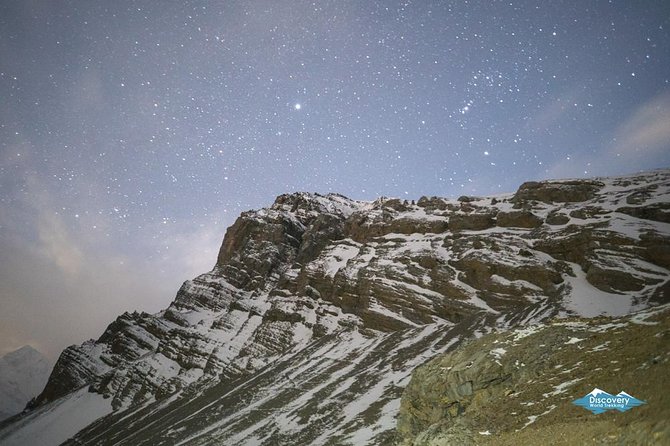
The Annapurna Circuit works because the scenery changes so sharply from day to day. You begin among farms, villages, rivers, and lower valley greenery. By the time you reach Manang, the air is colder and drier, the trees thin out, and enormous peaks dominate the horizon.
Adding Tilicho Lake makes the trip more demanding, but it also gives you a powerful extra goal before Thorong La. You are not simply walking from lodge to lodge. You are crossing several distinct mountain zones, with a guide handling route decisions and daily logistics while you focus on pace, weather, and your own energy.
The price is $1,093. That is a useful value if you want a structured trek rather than arranging each lodge, meal, permit, vehicle, and guide separately. The package includes Annapurna Conservation Area and TIMS permits, tea-house accommodation, three meals a day during the trek, guide and porter costs, transport on several sections, a Pokhara hotel night with breakfast, farewell dinner, taxes, and assistance with rescue arrangements in a serious health emergency.
You should still budget for anything not listed as included. The package description says unlisted costs are extra, and the optional flight from Pokhara to Kathmandu is not included. The return by tourist bus is covered.
More Annapurna treks:
- Annapurna base camp trek 5 Days
★ 5.0 · 252 reviews - Annapurna Base Camp Trek
★ 5.0 · 111 reviews - Kathmandu to Annapurna Base Camp (ABC) 5-Day Trek
★ 5.0 · 102 reviews
Kathmandu to the Marsyangdi Valley on day one
The first day is mostly a road day. You leave Kathmandu early and spend about six to seven hours traveling roughly 190 kilometers toward Besishar and the trailhead area around Syange.
This is not dead time. The road passes farms, villages, flowing rivers, and early views of the mountain ranges. It does, however, set the tone for the trip: Nepal’s mountain transport can be slow and tiring, and the first transfer is a substantial part of the day.
The early stop is listed as Sandup Choeding Gompa, with admission included. From there, the route begins to feel less like a city departure and more like a mountain journey. You should expect basic conditions and a long first day, even though the walking has not fully begun.
Tal, Chame, and the first Annapurna views
On day two, you cross a suspension bridge and climb toward Tal, entering the Manang region. Waterfalls, sandy riverbanks, and steep valley walls give this section a strong sense of place. The trail is not simply a march toward the high pass. Small settlements and changing river scenery keep the lower section interesting.
Day three follows a river through pine, fir, oak, and maple forest toward Chame, the administrative center of Manang District. This is one of the greener parts of the route, with forest overhead and mountain views opening through the trees.
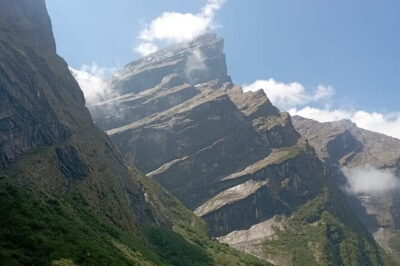
Day four brings a narrower valley and the striking Paungda Danda rock face, which rises about 1,500 meters above the river. You also get views toward Annapurna II and Pisang Peak. This is where the scale of the trek starts to register. The valley feels more enclosed, yet the peaks begin to look closer and more imposing.
The walking days are listed as full-day stages. Exact walking hours are not provided for every day, so your guide’s pace, weather, trail conditions, and group size will matter. The maximum group size is 15, which is large enough for company but small enough for the guide to manage more easily than a big coach-style group.
Pisang to Manang, with a real acclimatization day
On day five, you take the upper route through Upper Pisang and Geru. This route is chosen for its views of Annapurna II, Annapurna III, Annapurna IV, Gangapurna, Tilicho, and Pisang Peak. As you climb, the air becomes colder, drier, and harsher.
That change is important. Altitude is not just a number on a sign. It affects sleep, appetite, breathing, and walking speed. The program does not rush straight from the lower valley to Thorong La. Day six is set aside around Manang for acclimatization.
You hike toward Gangapurna Lake and Base Camp, admire the surrounding peaks, explore Manang village, and visit a monastery. This is a strong design choice. You still walk and see something worthwhile, but you sleep at the same general altitude rather than gaining height too quickly.
Use this day sensibly. It is not the place to prove how fast you can climb. Drink what your guide recommends, eat even if your appetite fades, and tell the guide promptly if you feel unwell. The company states that it can assist with rescue arrangements in a complicated health situation, but that support is not a substitute for taking altitude symptoms seriously.
More day hikes and treks in Kathmandu:
- Everest Base Camp Trek – 14 Days
★ 5.0 · 1,499 reviews - Everest Base Camp Trekking
★ 5.0 · 485 reviews - Nagarkot Sunrise View and Day Hiking from Kathmandu
★ 5.0 · 471 reviews - Everest Base Camp Trekking – 13 Day
★ 5.0 · 365 reviews
The Tilicho Lake detour through Khangsar
Day seven heads toward Khangsar, a Tibetan settlement reached by an upper route, a river crossing, and several hours through conifer forest. The program calls this an easier day, but it still involves mountain walking and a change in altitude.
Khangsar is one of the cultural highlights of the route. The settlement leads you toward the Tilicho side trip, and the surrounding terrain feels more exposed and rugged than the forested lower valley. On the following stage, you walk through an area marked by landslides and unusual rock formations before reaching Tilicho Base Camp.
The base camp itself is less about comfort than position. You stay close to the next morning’s climb and gain views of Tilicho Peak and snow-covered mountains. Tea-house accommodation is included, but you should expect the practical simplicity that comes with high mountain lodging.
The climb to Tilicho Lake starts early on day nine to avoid the stronger afternoon wind. From base camp, the route rises steeply and consistently for two to three hours. The lake is described as one of the world’s highest, and the setting is the reward: a broad, high basin surrounded by snowy peaks and stark mountain terrain.
This is one of the days that separates the trek from an easier Annapurna route. The climb is short on paper but hard at altitude. You may find the return descent just as tiring, since steep downhill walking puts plenty of strain on knees and ankles. Good boots, a steady pace, and patience matter more here than speed.
Khangsar, Yak Kharka, and Thorong Phedi
After Tilicho Lake, you descend toward the uninhabited Khangsar area and pass Tare Gumba, described as a thousand-year-old monastery. The route then follows a rock wall, crosses a bridge, and enters the Thorong Khola valley before climbing toward Yak Kharka.
This section links two major parts of the trip. You leave the special detour to Tilicho and return to the main crossing route toward Thorong La. The scenery remains open and severe, with fewer trees and more exposed slopes.
Day eleven continues uphill to Thorong Phedi, a small and busy settlement below the pass. You get views of Mt. Gundang, Mt. Syagang, Thorung Peak, and Mt. Khatungkan. The stop is practical as well as scenic. You are positioning yourself for the hardest day of the trek.
Do not expect Thorong Phedi to feel like a resort. The accommodation is tea-house based, and the main reason for staying there is to make the pass crossing possible. Rest, organize your daypack, and follow your guide’s instructions about the morning departure.
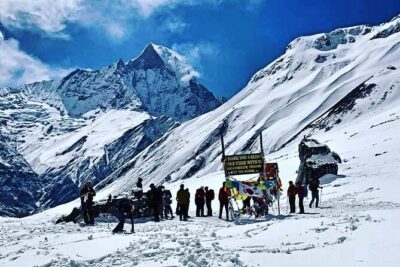
Thorong La at 5,416 meters
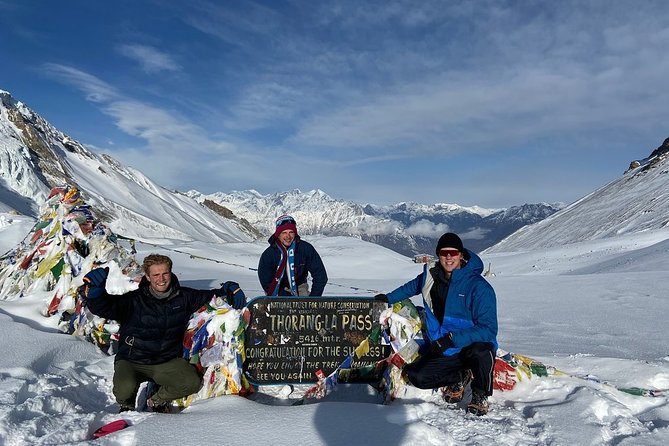
Day twelve begins around 3 a.m. That early start is designed to get you over Thorong La before conditions worsen later in the day. The pass reaches 5,416 meters, making it the highest point of the trek and its most physically demanding challenge.
The climb is steady and exposed. You need to push yourself, but this is not a race. The success of the day depends on a controlled pace, warm clothing, food, water, and attention to how your body is responding.
Reaching the pass is a major achievement, but the day does not end there. You descend toward Muktinath, and downhill walking after a high-altitude climb can feel punishing. Plan for tired legs when you arrive.
Muktinath is both a mountain destination and an important religious site. Visiting the temple after the pass gives the day a strong cultural finish. It also helps explain why this route is more than a sequence of viewpoints. The villages, monasteries, and sacred places are part of the journey, not decoration around it.
Muktinath to Tatopani and a welcome soak
After visiting Muktinath, you continue by car toward Tatopani. This is one of the route’s necessary transport sections, and it gives your legs a break after Thorong La.
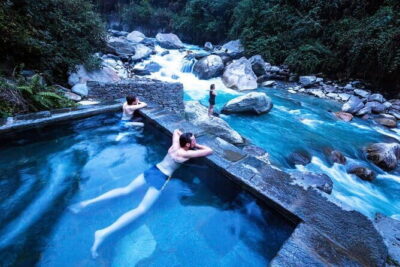
Tatopani is known for natural hot springs. After several days of cold mornings, steep climbs, and basic accommodation, soaking in warm water can be a genuine pleasure. The stop also changes the mood of the trek. You have crossed the highest pass, and the route begins to return toward greener country.
The included transport from Muktinath to Tatopani is valuable because arranging local vehicles on your own can add uncertainty to an already long trip. As with all mountain roads, you should be prepared for a slower ride than the map may suggest.
Rhododendron forest, Ghorepani, and Poon Hill
Day fourteen is a walking day through the villages of Sikha and Chitre toward Ghorepani. The communities are associated with the Thakali people, and the route passes terraced farmland with mountains around you.
The vegetation changes again. You walk through forests of rhododendron, birch, and magnolia before reaching Ghorepani. After the dry upper country, this return to trees and cultivated hillsides feels refreshing.
Day fifteen begins early with the climb to Poon Hill at 3,210 meters. The reward is sunrise over the Annapurna and Dhaulagiri massifs, with views toward Machhapuchhre, or Fishtail, and Mt. Manaslu. Rice terraces add a human scale below the peaks.
Poon Hill is a popular viewpoint, and the early start means you will not have it to yourself. Still, it is a sensible final highlight. After the strain of Tilicho Lake and Thorong La, the sunrise gives you a clear, visual ending before the return journey.
What the guide and porter support means
The company provides a government-licensed guide and covers the guide and porter team’s meals, insurance, salary, lodging, and transport. That matters on a route with several transfers, confusing junctions, changing altitude, and weather-sensitive decisions.
Specific guides associated with recent departures include Hari Gurung, Suresh, and Dev, with porters including Damar, Sangkar, Bikesh, Asis, and Monis. Staff assignments can change, so you should not book expecting a particular person unless the company confirms it.
The strongest pattern in the feedback is personal care. Guides are praised for explaining mountains, towns, and local culture, while porters are described as supportive and friendly. One especially practical touch was Monis preparing fruit platters in the evenings. Small gestures like that can matter after a long day.
The right expectation is not luxury service. It is dependable support in a place where route knowledge, carrying help, and calm decisions have real value.
Food, lodging, transport, and the true cost
Three meals a day are included during the trek, and the package also covers breakfast on the hotel night in Pokhara, along with farewell dinner. Extra dietary requirements can be catered for, according to the package details.
Tea-house lodging keeps the price manageable and puts you close to the route. It also means you should be ready for basic rooms and shared facilities, since the package does not promise hotel-style comfort throughout.
Transport is a major part of this trip. You drive from Kathmandu to the starting area, use local transport from Muktinath to Tatopani, continue toward Pokhara, and return to Kathmandu by tourist bus. A 225-minute flight from Pokhara is available as an alternative, but it costs extra.
At $1,093, the package is best judged as a logistics bundle. You are paying for a licensed guide, porter support, permits, meals, lodging, several road transfers, staff expenses, taxes, rescue assistance, and a planned route. It is less attractive if you already have strong trekking experience and prefer to arrange every detail yourself.
Who should book this Annapurna trek
You should consider it if you are fit, active, and comfortable walking for full days at high altitude. It suits someone who wants the classic circuit but also wants Tilicho Lake, Muktinath, Tatopani, and Poon Hill in one trip.
It is also a good fit if you value human support. The guide and porter system removes much of the planning burden and gives you help with route finding, local context, meals, lodging, and difficult sections.
You should think twice if you dislike early mornings, long road transfers, simple lodging, steep climbs, or uncertain mountain conditions. The trek requires good weather, and the company may cancel if conditions are poor or if the minimum group size is not met. The policy is strict: the experience is non-refundable and cannot be changed after booking, except where the company cancels and offers another date or a full refund.
Should you book it?
Book this trek if your priority is a well-supported Annapurna challenge with several major highlights in one 16-day route. Tilicho Lake and Thorong La give the trip real substance, while Tatopani and Poon Hill keep the second half varied.
Skip it if you want a soft adventure or a flexible, independent trip. The early pass day, high altitude, rough walking, road transfers, and basic tea houses demand preparation. For a fit hiker who wants the main Annapurna experiences handled by a guide and porter team, the $1,093 price offers solid practical value.
FAQ
How long is the Annapurna Circuit with Tilicho Lake trek?
The trip lasts approximately 16 days, beginning and ending in Kathmandu.
What is the highest point of the trek?
The highest point is Thorong La Pass at 5,416 meters.
How difficult is this trek?
It is designed for people with a moderate level of physical fitness, but the package describes it as a challenging mountain trek.
Is Tilicho Lake included?
Yes. The route includes a walk to Tilicho Lake from Tilicho Base Camp, with an early start to avoid afternoon wind.
Are meals included?
Yes. Breakfast, lunch, and dinner are included during the trek. Breakfast is also included for the hotel night in Pokhara, and a farewell dinner is provided.
Is accommodation included?
Yes. Tea-house or lodge accommodation is included during the trek, along with one night in a selected hotel in Pokhara.
Are permits included?
Yes. The Annapurna Conservation Area Permit and Trekkers Information Management System card fee are included.
Is transportation included?
Yes. The package includes transport from Kathmandu to the trailhead area, public transport from Muktinath to Tatopani, and a tourist bus from Pokhara to Kathmandu.
Can I fly from Pokhara to Kathmandu?
Yes. A flight from Pokhara taking about 225 minutes is offered as an alternative, but it is not included in the package price.
What happens if bad weather cancels the trek?
If the company cancels because of poor weather, you will be offered a different date or a full refund. The same applies if the minimum group size is not reached.
Just added around Kathmandu
- Traditional Momo Making Class★ 5.0 · 10 reviews
- Wildlife Adventure in Chitwan Nepal★ 4.0 · 4 reviews
- Walking tour of real Kathmandu through back streets.★ 5.0 · 3 reviews
- Kathmandu 2 Nights 3 Days Chitwan Jungle Safari Tour★ 5.0 · 9 reviews
- Kathmandu Street Food Walking Tour – Eat Like a Local★ 5.0 · 3 reviews
- Private Manaslu Circuit Trek at Himalayas★ 5.0 · 3 reviews
- Walking tour of Kathmandu with awesome local guides★ 5.0 · 4 reviews
- Visit Swayambhunath and Bauddhanath Stupa with Guide★ 5.0 · 5 reviews
Annapurna Treks from Kathmandu, compared.
Kathmandu to Annapurna Base Camp (ABC) 5-Day Trek
Read our review →
11-Day Hike Tour to Annapurna Base Camp Bliss in Kathmandu
Read our review →Browse the lists this tour appears in