
Reviewed · ANNAPURNA TREKS FROM KATHMANDU
10 Days Annapurna Circuit Trek
The high point is clear: you cross Thorong La Pass at 5,416 meters, then descend toward the sacred temple at Muktinath and the dry Kali Gandaki Valley. In ten days, you move from Kathmandu and subtropical river country to pine forests, high mountain villages, and a dramatic pass.
I like the practical package: meals, sleeping bags, guides, porters, private transport, and the Jomsom to Pokhara flight are covered. I also like the small maximum group size of 15, plus the chance to meet local staff such as Babu, Resham, and porter Rojit, who are named in the company’s past trip feedback.
The main concern is the pace. This is a short version of the Annapurna Circuit, with several hard walking days and a very high pass. You need moderate fitness, a serious approach to altitude, and comfort with basic mountain accommodation.
Key points to know before booking
- Thorong La is the physical centerpiece: The pass reaches 5,416 meters and is crossed on Day 8.
- The route covers about 160 to 230 kilometers: The distance varies with road and trail conditions, so this is a substantial trek.
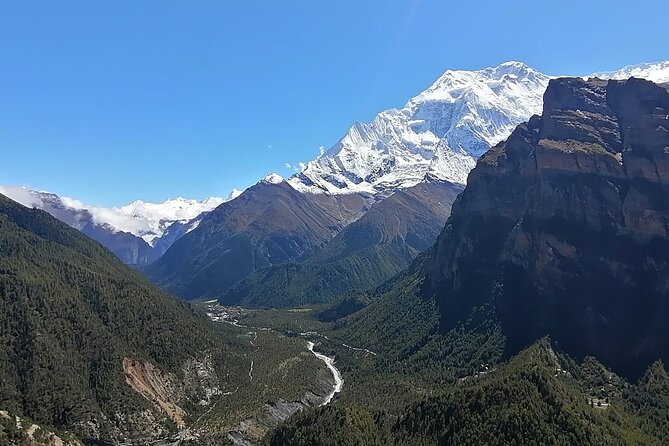
- The trip moves from Manang to Mustang: You see pine forest, high mountain valleys, Tibetan-style villages, arid country, and the Kali Gandaki Valley.
- A porter is assigned for every two people: This can make a major difference on long uphill days.
- The package includes the Jomsom to Pokhara flight: That saves a long return overland journey and gives you a memorable view of the Kali Gandaki Gorge.
- The cost is $1,430 per person: With meals, staff, sleeping bags, transport, and domestic airfare included, the price is reasonable if the compact schedule suits you.
What this 10-day Annapurna trek is really like
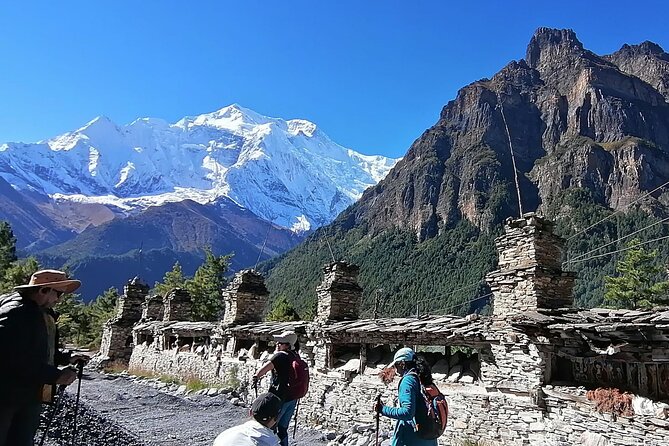
The Annapurna Circuit is appealing because the scenery changes almost every day. You do not simply walk toward one viewpoint and turn around. You travel around the Annapurna Massif, gaining height through river valleys and forests before reaching Manang, then crossing Thorong La and dropping into Mustang.
That variety is the great strength of this trip. You may see Annapurna II, Annapurna III, Gangapurna, Tilicho, Chulu East, Pisang Peak, Dhaulagiri, and the rock face of Paungda Danda. The route also brings you close to village life, Buddhist and Hindu religious sites, and old trading areas influenced by Tibet.
The itinerary is ambitious. Ten days leaves little spare time if weather, road delays, or altitude problems slow you down. You should see this as a focused trekking program rather than a relaxed walking holiday.
More Annapurna treks:
- Annapurna Circuit Trek with Tilicho Lake
★ 5.0 · 368 reviews - Annapurna base camp trek 5 Days
★ 5.0 · 252 reviews - Annapurna Base Camp Trek
★ 5.0 · 111 reviews
Day 1: Kathmandu to Besisahar with Manakamana on the way
Pickup is scheduled for around 7:00 to 7:15 in the morning from Himalayan Trekking and Tours on Yapikhya Marg in Kathmandu. The first day is mainly a road journey, listed at about seven hours and 185 kilometers, though mountain traffic and road conditions can affect the timing.
The route includes a stop at Manakamana Temple, a major religious site in Nepal. The temple gives the long transfer day a cultural point of interest rather than making it only a drive. You then continue toward Besisahar, where the first mountain views begin to appear.
This day is not a gentle introduction if you are tired from arriving in Nepal. Pack water and a few snacks within reach, since bottled water is not included. Private transport is included, but air conditioning is not listed, so do not assume the vehicle will have it.
Day 2: Forest trails and the route toward Chame
The second day brings you onto the mountain route. The trail climbs to Tyanja at about 2,360 meters, continues through forest near the river, and reaches Kopar at roughly 2,590 meters before Chame.
Chame is the headquarters of Manang District and one of the first places where the mountain setting feels fully present. The reward here is a view toward Annapurna II, one of the striking peaks of the range.
This is also where you begin to feel the cost of the condensed schedule. The route gains height early, and your body has limited time to adjust. Follow your guide’s pace rather than treating every uphill section as a race.
Day 3: Bridges, forest, and Paungda Danda
The trail starts through a deep forest in a steep, narrow valley. You cross a river on a long bridge at about 2,910 meters, then another bridge near 3,040 meters.
The most unusual sight is Paungda Danda, a soaring rock face that begins to appear as you gain height. The combination of bridges, steep valley walls, and changing mountain views gives this day a strong sense of progress.
The path can feel demanding because the valley is narrow and the route keeps climbing. Good footwear matters here. The tour provides a sleeping bag, but you should still bring your own warm layers and personal gear suitable for high-altitude nights.
More day hikes and treks in Kathmandu:
- Everest Base Camp Trek – 14 Days
★ 5.0 · 1,499 reviews - Everest Base Camp Trekking
★ 5.0 · 485 reviews - Nagarkot Sunrise View and Day Hiking from Kathmandu
★ 5.0 · 471 reviews - Everest Base Camp Trekking – 13 Day
★ 5.0 · 365 reviews
Day 4: Pine forest and the approach to Manang
The trail passes through aromatic pine forest before reaching the wider mountain setting around Manang. This is one of the most rewarding scenery days because the peaks begin to open up around you.
You are scheduled to see close views of Gangapurna, Annapurna II and III, Tilicho, Chulu East, and Pisang Peak. The views are not just distant snow peaks. They help you understand the scale of the Annapurna range as you walk beneath it.
Manang is an important pause point because the next section reaches much higher ground. The itinerary gives you time to explore the village on Day 5, which is useful for acclimatization, although the overall plan remains tight.
Day 5: Manang village and Gangapurna Lake
Day 5 is described as a village exploration day, with a visit to Gangapurna Lake. This is a welcome change from a long point-to-point march.
Manang offers a chance to see mountain life at close range. You can spend time around the village, meet local people, and visit the lake below the surrounding peaks. The setting helps break up the physical effort of the trek while keeping you in the high country.
The schedule information lists this day as 20 hours, which is almost certainly a timing error rather than a realistic walking duration. Confirm the actual plan with the operator before departure. The important point is that this day is intended for exploration and adjustment, not a normal full-day transfer.
Day 6: Manang to Yak Kharka and Ledar
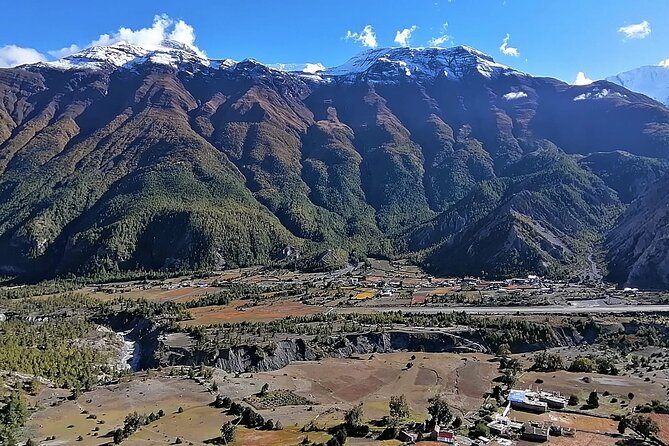
After leaving Manang, the trail climbs into the upper Marshyangdi Valley. The route passes Gunsang and continues toward Yak Kharka before reaching Ledar.
This is a strenuous ascent day. The surroundings become more open and exposed as the route moves above the tree line, and the combination of altitude and uphill walking can slow you down. The itinerary aims for arrival at Ledar before sunset, which is sensible because the high route is not a place to linger late.
This is where the porter arrangement becomes especially useful. One porter is assigned to two people, so you can walk with a lighter daypack. Pack only what you need for the day, but keep warm clothing, water, and essential medication with you.
Day 7: Thorung Phedi and unstable slopes
The route follows the east bank of the Jorsang Khola toward Thorung Phedi. The path is described as narrow, with unstable slopes and difficult sections.
Thorung Phedi is the staging point for the next morning’s pass crossing. You stay overnight here, and the practical goal is simple: rest, eat, prepare your clothing, and follow your guide’s advice.
Do not underestimate this night. You are about to cross the highest point of the trip, and sleep can be less comfortable at altitude. Keep your gear organized so you are not repacking in the dark or searching for gloves and headwear before an early start.
Day 8: Thorong La Pass and Muktinath
This is the hardest and most memorable day. You climb rocky ridges toward Thorong La Pass, at 5,416 meters, the highest point on the route.
From the pass, the itinerary promises views across the Dhaulagiri range. The pass itself is the payoff for the long ascent, but the crossing can be physically demanding because of height, cold, wind, and uneven ground. Your guide’s judgment matters here. If you feel unwell, tell the guide early rather than trying to hide symptoms.
After crossing Thorong La, you descend to Muktinath, one of the important religious sites in the Mustang region. The temple is sacred and draws both Hindu and Buddhist pilgrims. The visit adds cultural weight to a day that could otherwise be remembered only as a mountain challenge.
Admission to Thorong La and Muktinath is not included, according to the tour information. The listed visit times are brief, so expect an overview rather than a long religious or architectural study.
Day 9: Down the Kali Gandaki Valley to Jomsom
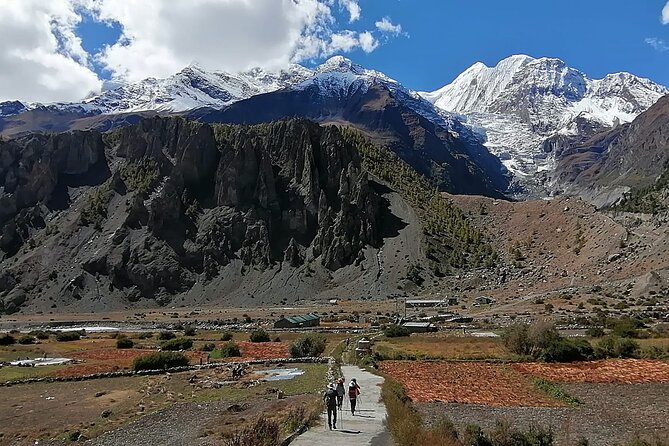
The next day changes character quickly. You descend through the dramatic Kali Gandaki Valley, leaving the high pass behind and entering drier country.
The trail passes through Jharkot and Khingar, described as typical Tibetan villages, before following the valley floor toward Jomsom. The dry surroundings, stone villages, and broad views provide a sharp contrast with the pine forest and snowy peaks earlier in the trip.
This descent may feel easier than the pass day, but downhill walking can be hard on knees and ankles. Use trekking poles if you normally rely on them, and keep your pace controlled. Jomsom is also important because it is the departure point for the flight to Pokhara.
Day 10: Jomsom to Pokhara by air
After breakfast, you take the morning flight from Jomsom to Pokhara. The flight is included and is described as passing above the Kali Gandaki Gorge, with views toward Dhaulagiri and the Annapurna ranges.
This is a smart ending for a short itinerary. Instead of spending another long day on roads, you return to Pokhara quickly and retain time to visit the city. The listed free time includes the option of boating on Fewa Lake.
Flight schedules in mountain regions can be affected by conditions, so keep your plans in Pokhara flexible. The itinerary says the activity ends back at the Kathmandu meeting point, but Day 10 specifically describes arrival in Pokhara. Confirm the final drop-off arrangement before booking, since the written details point to different end locations.
What the $1,430 price includes
At $1,430 per person, the package has solid coverage for a 10-day Nepal trek. Included items are:
- Private transportation
- Guide services
- Porters, with one porter for every two people
- Sleeping bag
- Breakfast, lunch, and dinner
- Coffee or tea
- All fees and taxes
- Domestic flight from Jomsom to Pokhara
The meal count is listed as 11 breakfasts, 10 lunches, and 10 dinners. That is generous on paper, though you should confirm how the extra breakfast fits the actual schedule.
The value depends on what you compare it with. A self-planned trek would still require transport, meals, staff, sleeping equipment, and the flight. Here, the price also buys coordination on a route where timing, altitude, and transport can complicate plans.
The exclusions are modest but worth noting. Bottled water and alcoholic drinks are extra. Air-conditioned transport is not included, and entrance charges for the Thorong La and Muktinath stops are listed separately. You should also confirm personal expenses before setting your budget.
Guides, porters, and the human side of the trek
The company’s trip feedback names guides including Babu and Resham, along with porter Rojit. Babu is described as helpful and attentive on mountain trips, while Resham is noted for being accommodating. Your actual guide and porter may be different, but asking for the assigned team before departure is sensible.
The strongest service point is the staff support. On a route with altitude concerns, a good guide does more than point out peaks. You need someone who watches the group, adjusts the pace, and takes symptoms seriously.
One account describes a hiker developing altitude trouble and receiving help from the guides. That is not a reason to treat altitude casually. It is a reminder to speak up early and follow the guide’s instructions.
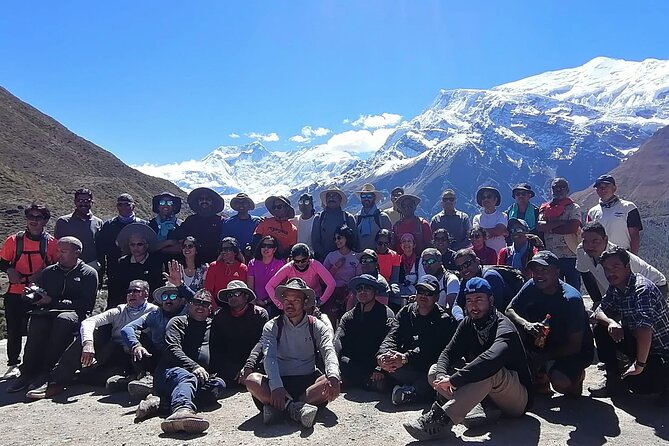
The group limit is 15 people. That is small enough for practical support, though the experience will still depend on the final group size and staff-to-hiker arrangement.
Who should book this trek?
This trip suits you if you want a serious Himalayan route but prefer a package that handles the main logistics. It is a good match for people who value mountain scenery, village contact, cultural sites, and a clear support system.
It can also suit a first multi-day trekker who has moderate fitness and accepts that this will be demanding. A first trek is not a problem by itself, but the 5,416-meter pass and short schedule require preparation.
You should think twice if you want slow walking days, luxury accommodation, or a generous buffer for weather and altitude. The price includes useful comforts, but this is still a high-altitude trek with basic mountain conditions and long walking days.
Final verdict: a strong value trek with a demanding schedule
I would recommend this Annapurna Circuit package to a fit hiker who wants the route’s biggest highlights in ten days and values having guides, porters, meals, sleeping gear, transport, and a domestic flight arranged in advance.
The best reasons to book are the spectacular change in scenery, the pass crossing, the Muktinath visit, and the convenient flight to Pokhara. The main reason to hesitate is the compressed timetable. Confirm the Day 5 timing, the final drop-off point, the exact inclusions for admission fees, and the assigned staff before paying.
Free cancellation is available up to 24 hours before the scheduled start time for a full refund. Changes or cancellations made inside that window are not accepted or refunded.
FAQ
How long is the Annapurna Circuit trek?
The experience lasts approximately 10 days. The route covers about 160 to 230 kilometers, or roughly 100 to 145 miles, depending on the exact route and conditions.
What is the highest point of the trek?
The highest point is Thorong La Pass, at 5,416 meters. It is crossed on Day 8.
Is the Jomsom to Pokhara flight included?
Yes. The domestic flight from Jomsom to Pokhara is included in the package.
Are meals included?
Yes. Breakfast, lunch, and dinner are included. The information lists 11 breakfasts, 10 lunches, and 10 dinners, along with coffee or tea.
How many people can join the group?
The maximum group size is 15 people.
What fitness level is required?
A moderate level of physical fitness is required. The trek includes long uphill sections, narrow and unstable paths, high altitude, and the crossing of Thorong La Pass.
Just added around Kathmandu
- Traditional Momo Making Class★ 5.0 · 10 reviews
- Wildlife Adventure in Chitwan Nepal★ 4.0 · 4 reviews
- Walking tour of real Kathmandu through back streets.★ 5.0 · 3 reviews
- Kathmandu 2 Nights 3 Days Chitwan Jungle Safari Tour★ 5.0 · 9 reviews
- Kathmandu Street Food Walking Tour – Eat Like a Local★ 5.0 · 3 reviews
- Private Manaslu Circuit Trek at Himalayas★ 5.0 · 3 reviews
- Walking tour of Kathmandu with awesome local guides★ 5.0 · 4 reviews
- Visit Swayambhunath and Bauddhanath Stupa with Guide★ 5.0 · 5 reviews
Annapurna Treks from Kathmandu, compared.
Kathmandu to Annapurna Base Camp (ABC) 5-Day Trek
Read our review →
Browse the lists this tour appears in