
Reviewed · EVEREST BASE CAMP TREKS FROM KATHMANDU
Gokyo to Everest Base Camp Trek
The best thing about this trek is the route itself: you reach Gokyo Lakes and Gokyo Ri before crossing Cho La Pass to Everest Base Camp. That gives you turquoise mountain lakes, a high glacier pass, Sherpa villages, Kala Patthar, and the Khumbu Glacier in one demanding circuit rather than a simple out-and-back walk.
I love the two-night stay in Gokyo, which gives you time to climb Gokyo Ri for views toward Everest, Cho Oyu, and Makalu. I also like the practical setup: flights between Kathmandu and Lukla, meals on the trail, a guide, a porter for every two clients, permits, filtered water, a sleeping bag, and a down jacket are all included.
The drawback is plain: this is a serious high-altitude trek. Cho La reaches about 5,300 meters, Kala Patthar reaches 5,555 meters, and the day to Everest Base Camp is long. Accommodation becomes basic, weather can disrupt flights and crossings, and insurance with high-altitude rescue and evacuation cover is your responsibility.
Key points to know before booking
- Gokyo comes before Everest Base Camp: You see the quieter Gokyo Valley and lakes before joining the main Everest route.
- Cho La is the physical crux: The pass requires an early start, careful pacing, and favorable conditions.
- The group is capped at 15 people: That keeps the group manageable while still offering the social feel of a shared trek.
- Several major costs are included: Domestic flights, permits, meals, guide services, porter support, water filtration, and basic cold-weather gear reduce surprise expenses.
- Guides are central to the experience: Depending on the departure, you may be paired with staff such as Nima, Raj Kumar, Lakpa Sherpa, Ganesh, or another Ace the Himalaya guide.
- Weather planning matters: Lukla flights and the Cho La crossing can change with conditions, so flexibility is part of the deal.
Why the Gokyo to Everest route is worth the effort
Most people first picture Everest Base Camp as a single famous destination. This trip gives you something broader. You walk through the Dudh Koshi valley, reach the source area around Gokyo, cross a high pass, then approach Everest from the east through the Khumbu.
That extra arc changes the feel of the trek. Gokyo brings open mountain views and a quieter setting before you meet the heavier traffic of the main Base Camp route. The price is extra effort, especially around Cho La, but you get far more than a standard Base Camp itinerary.
The trek also connects you with Sherpa communities in places such as Namche Bazaar, Phortse, Thangnak, Lobuche, and the villages around Tengboche. Buddhist monasteries, prayer flags, suspension bridges, yak trails, and high stone settlements are not side details here. They are the fabric of the journey.
At $2,200 per person, the cost is reasonable for a 17-day supported trek in Nepal, provided you use the included services. Kathmandu airport transfers, two hotel nights, domestic airfare, 14 nights of guest house accommodation, meals during the trek, permits, staff, a duffel bag, and rented cold-weather items would be expensive and time-consuming to arrange separately.
You still need to budget for Kathmandu lunches and dinners, drinks, international airfare, a Nepal entry visa, personal equipment, insurance, and tips. The tipping expectation is worth noting early, since it is part of the normal cost of hiring trekking staff in Nepal.
More Everest Base Camp treks:
- Everest Base Camp Trek – 14 Days
★ 5.0 · 1,499 reviews - Everest Base Camp Trekking
★ 5.0 · 485 reviews - Everest Base Camp Trekking – 13 Day
★ 5.0 · 365 reviews
Days 1 and 2: Kathmandu to Lukla and Phakding
Your trip begins with an airport pickup at Tribhuvan International Airport. An Ace the Himalaya representative meets you outside the terminal, then transfers you to your Kathmandu hotel.
The next morning brings the famous 35-minute flight to Tenzing and Hillary Airport in Lukla, at 2,804 meters. The flight is short, but it is a major transition from city travel to mountain trekking. Your guide briefs you after arrival, and the walk toward Phakding begins.
Phakding is a useful first stop because you start gaining height without immediately facing the hardest sections. The day is still long in the schedule, and you should treat it as the beginning of your acclimatization, not as a relaxed stroll.
The Lukla flight is one of the less predictable parts of the trip. The activity requires good weather, and a delay can affect the rest of the schedule. Keep your first and last days in Nepal flexible if possible, and carry essential items in your hand luggage.
Days 3 and 4: Namche Bazaar and your first acclimatization day
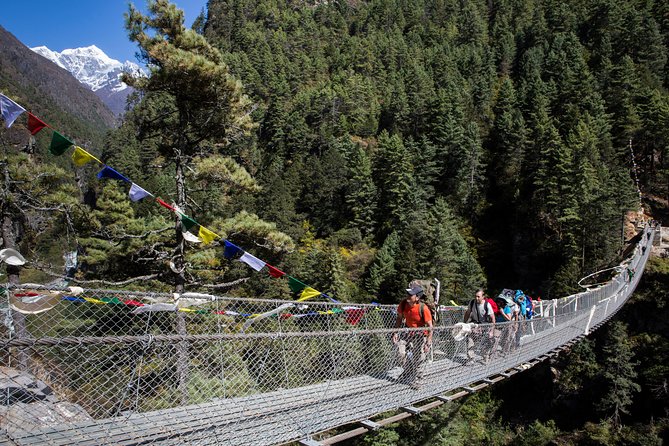
From Phakding, the trail follows the Dudh Koshi. You cross suspension bridges decorated with prayer flags and enter Sagarmatha National Park before climbing toward Namche Bazaar.
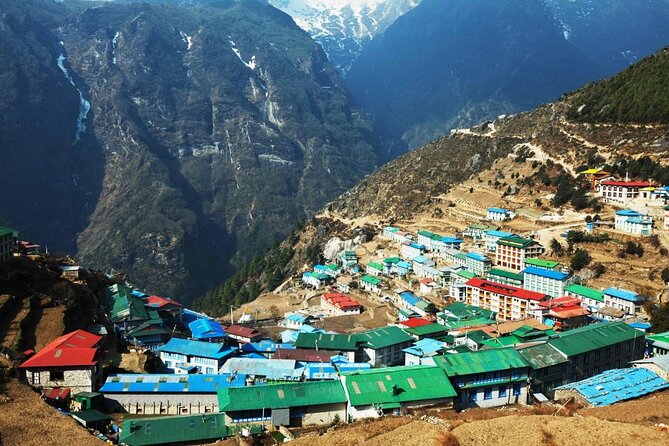
Namche is more than a place to sleep. It is the main trading and supply center of the Khumbu region, and it is where the itinerary gives your body time to adjust to thinner air. The planned acclimatization walk goes to a museum focused on Sherpa customs and mountain culture.
I like this pause because it treats altitude as a real concern rather than something you can ignore. You will probably want to explore the town, but the main goal is to walk lightly, rest, drink water, and avoid turning the day into a second hard trek.
The accommodation in Lukla, Phakding, and Namche includes guest houses with attached toilets. That is a useful comfort during the early part of the route, but standards become simpler as you go higher.
Days 5 and 6: Phortse, Machhermo, and the turn toward Gokyo
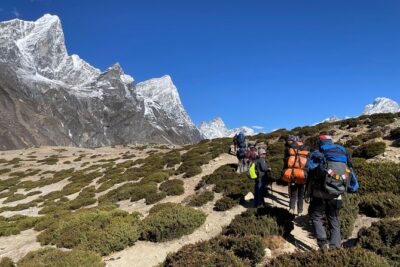
The trail climbs through rhododendron forest toward Phortse. As the altitude increases, juniper and large conifers appear. In spring, the vegetation can make this section feel surprisingly lush, though the effort of climbing remains constant.
You pass through yak-grazing country and continue toward Machhermo. The route climbs a ridge with views down toward Kengtega and up toward Cho Oyu, then drops toward a river before rising again toward the terminal moraine of the Ngozumpa Glacier.
This is where the trip begins to feel more remote. You are not simply following the most direct line to Base Camp. You are moving toward the glacier and the Gokyo Valley, with more demanding elevation changes and fewer easy comforts.
The itinerary describes some days as very long, so do not judge the trek only by distance. At altitude, a short climb can take time. Your guide’s pacing and willingness to adjust the plan matter greatly here. Guides such as Nima, Raj Kumar, Lakpa Sherpa, and Ganesh have been praised for making safety-first decisions and adapting to weather or trail conditions. The assigned guide may differ on your departure.
More day hikes and treks in Kathmandu:
- Nagarkot Sunrise View and Day Hiking from Kathmandu
★ 5.0 · 471 reviews - Annapurna Circuit Trek with Tilicho Lake
★ 5.0 · 368 reviews - Everest Base Camp Trek -14 Days
★ 5.0 · 321 reviews - Annapurna base camp trek 5 Days
★ 5.0 · 252 reviews
Days 7 and 8: Two nights in Gokyo and the climb to Gokyo Ri
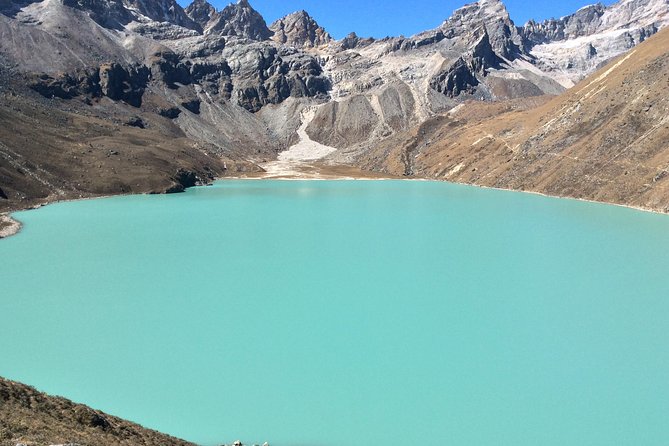
Gokyo sits at about 4,790 meters and becomes your base for two nights. The village and its lakes are the visual reward for taking the western route before crossing toward Everest.
The extra night is important. It gives you a chance to see the area without carrying your full trekking load, while also allowing more time to adjust before Cho La. The setting around the lakes is one of the most memorable parts of the route, especially with the surrounding peaks reflected in the water when conditions are clear.
The main outing is the early climb to Gokyo Ri, listed at 5,483 meters. It is steep, but the views are the reason to make the effort. You can expect broad views toward Cho Oyu, Everest, Makalu, and the Gokyo Valley.
This is an optional-feeling challenge in practice, but it is one of the trip’s defining moments. Start slowly and let your guide set the rhythm. At this elevation, rushing the first part can make the upper section much harder.
Days 9 and 10: Thangnak and the Cho La crossing
From Gokyo, you trek toward Thangnak, at the foot of Cho La. The accommodation here is specifically described as very basic, with dormitory-style rooms because of the remote location.
That detail matters. You are not paying for a luxury lodge circuit. You are choosing access to high Himalayan routes, and some nights require a willingness to accept limited privacy and simple facilities.
Cho La is the toughest logistical point of the itinerary. The group starts around 4:00 or 5:00 in the morning to reach the pass by about 9:00 or 10:00, before afternoon weather becomes more difficult. The crossing reaches roughly 5,300 meters.
The early start may feel harsh, but it serves a purpose. You want daylight, stable conditions, and enough time to cross without being caught by changing weather later in the day. The pass can bring snow and difficult footing, so your guide’s call on timing and safety is crucial.
The route is demanding, but it is also why this trek feels like a true circuit. You are not just ticking off Base Camp. You are crossing a serious Himalayan pass to connect two major valleys.
Days 11 and 12: Lobuche and Everest Base Camp
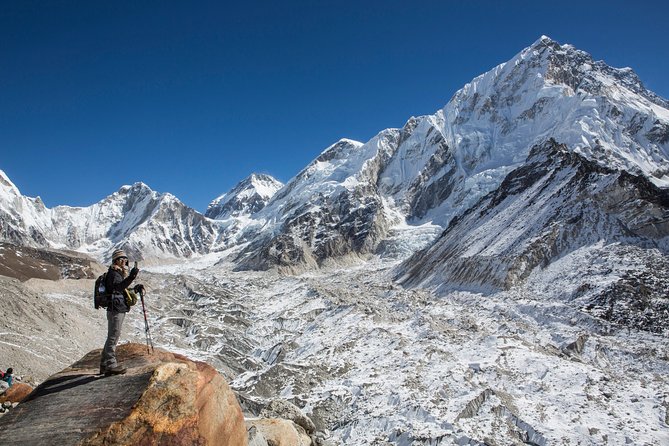
After Cho La, the trek to Lobuche is described as shorter and easier, at about four hours. That makes it a useful recovery day after the pass, though you remain at high altitude and should not expect a completely effortless walk.
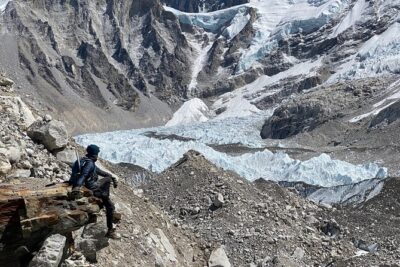
The next day is the famous push to Everest Base Camp. You follow the Khumbu Glacier toward Base Camp at about 5,365 meters. This is a long, difficult day, and the altitude can make the glacier route feel slower than expected.
Base Camp is a powerful goal, but keep your expectations practical. You are not climbing Everest, and the camp changes with the mountaineering season. In spring, you may see expedition activity, but access and conditions can vary.
The best part of the approach is the sense of progression. You have already crossed from Gokyo, passed Cho La, and reached Lobuche. The Base Camp walk then feels like the next step in a much larger journey, not a quick photo stop reached by the easiest route.
Day 13: Kala Patthar and the best Everest viewpoint
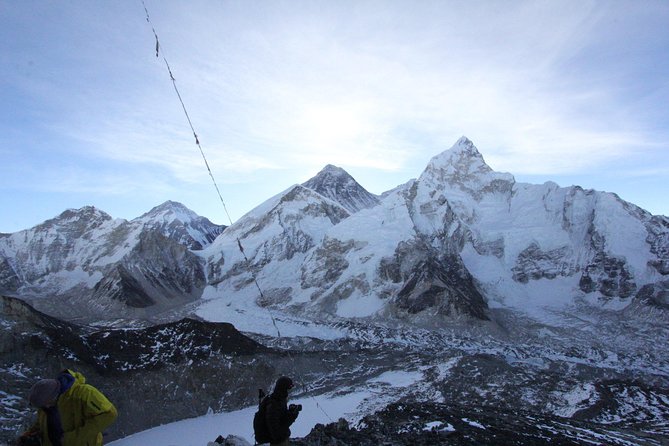
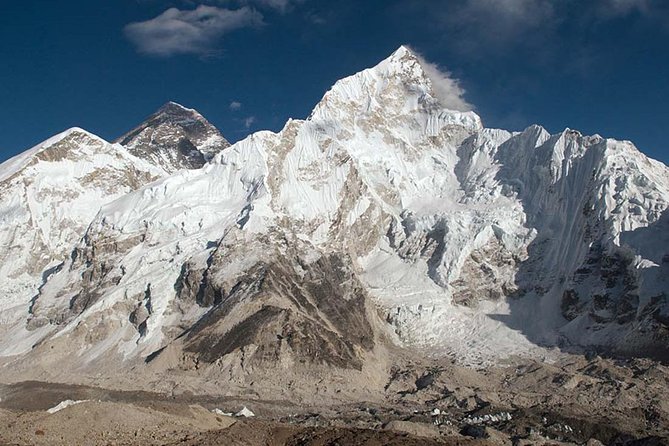
The climb of Kala Patthar is listed as one of the hardest and most rewarding days. The summit reaches about 5,555 meters, higher than Everest Base Camp itself.
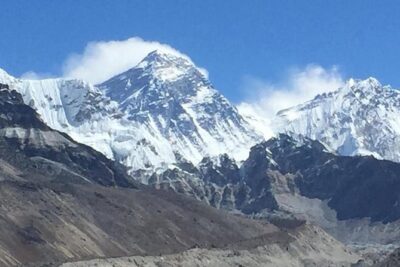
The path is steep, and much of the morning goes into climbing. The reward is the view toward Everest and the surrounding peaks. If you are choosing between a high viewpoint and a famous destination, Kala Patthar is arguably the stronger visual experience.
Do not underestimate the effort just because the summit is called a small peak. At this height, every step can feel slow. Your success may depend less on speed than on a steady pace, warm layers, water, and patience.
The included down jacket and sleeping bag are useful here, but you still need personal trekking equipment. The information does not specify a full equipment list, so confirm what you need before arrival rather than assuming the provided gear covers everything.
Days 14 to 16: Returning through Namche and Lukla
The descent goes through Pangboche and Tengboche before returning to Namche. Tengboche is known for its Buddhist monastery, and this section gives you a chance to see familiar mountains from a lower and more comfortable angle.
Reaching Namche again feels like a real change. The air is easier, facilities are less basic, and the pressure of the highest sections has passed. You then continue to Lukla for the final trekking day.
The last afternoon in Lukla is free, giving you time to reflect on the route and your own progress. The next day, you take the 35-minute flight back to Kathmandu and transfer to your starting hotel.
Again, weather can affect the flight. A delayed Lukla departure is not a minor inconvenience if it threatens your international connection, so avoid scheduling your flight home too tightly after the trek.
What the $2,200 package actually covers
The package is strongest when you value support and simplicity. Included services are:
- Airport transfers in Kathmandu
- Two nights in a three-star Kathmandu hotel
- Fourteen nights of twin-share guest house accommodation
- A licensed English-speaking guide
- One porter for every two clients
- Trekking permits and government charges
- Kathmandu to Lukla and return airfare
- Breakfast for 16 days
- Lunch and dinner for 14 days
- Filtered trail water using a Katadyn Pocket Water Filter
- Seasonal fruit during the trek
- A down jacket, sleeping bag, duffel bag, and sun hat
You pay separately for Kathmandu meals, alcoholic and other drinks, personal gear, visa costs, international flights, insurance, and tips. Travel insurance must cover emergency high-altitude rescue and evacuation. Do not treat that as optional paperwork.
The group maximum is 15 people. That is large enough to share the experience but small enough for the guide to keep an eye on pace and condition. Group discounts are offered, though the exact discount is not specified.
Who should book this trek?
You should consider it if you already walk regularly, can handle long uphill days, and are comfortable sleeping in simple mountain accommodation. A moderate fitness level is required, but the altitude and the Cho La crossing make this more demanding than an ordinary walking holiday.
It suits someone who wants both the Gokyo Valley and Everest Base Camp, not someone who wants the shortest possible route to Base Camp. It also suits people who value organized support, since the company handles permits, staff, flights, food, water filtration, and airport transfers.
You may want a different trip if you dislike early starts, dormitory accommodation, changing plans, or strenuous climbs above 5,000 meters. You should also think twice if you cannot allow flexibility around weather delays.
Cancellation is generous if handled early: cancel at least six full days before the start for a full refund. Two to six full days allows a 50 percent refund, while cancellation less than two full days before departure is nonrefundable. A weather cancellation offers a different date or full refund.
Should you book the Gokyo to Everest Base Camp Trek?
I would book this trek if you want the most varied version of the Everest region and accept that the best views come with hard work. The Gokyo Lakes, Gokyo Ri, Cho La, Everest Base Camp, and Kala Patthar give you a powerful sequence of goals, while the included guide, porter, meals, permits, flights, and gear make the $2,200 price easier to justify.
Choose it with open eyes. The pass is serious, the highest days are tiring, and weather can rearrange your plans. If you are prepared for that, this route offers more range and more mountain time than a basic Base Camp trek.
FAQ
How long is the Gokyo to Everest Base Camp Trek?
The trek lasts approximately 17 days, including airport transfers, the Kathmandu hotel stays, the Lukla flights, the trek, and the final airport departure.
Where does the trek start and end?
It starts with pickup at Tribhuvan International Airport in Kathmandu. After the trek returns from Lukla, the activity ends back at the Kathmandu meeting point after the final airport transfer.
How high does the trek go?
The route reaches about 5,483 meters at Gokyo Ri, about 5,300 meters at Cho La Pass, about 5,365 meters at Everest Base Camp, and about 5,555 meters at Kala Patthar.
Is the trek suitable for beginners?
The activity requires a moderate level of physical fitness. It includes long trekking days, steep climbs, a high pass, and several sections above 5,000 meters, so it is not a casual walking tour.
Are flights between Kathmandu and Lukla included?
Yes. The package includes Kathmandu to Lukla and return airfare, with each flight taking approximately 35 minutes when operating.
What meals are included?
Breakfast is included for 16 days, while lunch and dinner are included for 14 days during the trek. Lunch and dinner in Kathmandu are not included.
Is accommodation included?
Yes. The package includes two nights in a three-star hotel in Kathmandu and 14 nights in twin-share guest houses. Accommodation in Thangnak is described as basic and dormitory-based.
Is travel insurance included?
No. You must arrange your own travel insurance, and it must cover emergency high-altitude rescue and evacuation.
Just added around Kathmandu
- Traditional Momo Making Class★ 5.0 · 10 reviews
- Wildlife Adventure in Chitwan Nepal★ 4.0 · 4 reviews
- Walking tour of real Kathmandu through back streets.★ 5.0 · 3 reviews
- Kathmandu 2 Nights 3 Days Chitwan Jungle Safari Tour★ 5.0 · 9 reviews
- Kathmandu Street Food Walking Tour – Eat Like a Local★ 5.0 · 3 reviews
- Private Manaslu Circuit Trek at Himalayas★ 5.0 · 3 reviews
- Walking tour of Kathmandu with awesome local guides★ 5.0 · 4 reviews
- Regular Yoga for all levels of practitioners in Kathmandu★ 5.0 · 4 reviews
Everest Base Camp Treks from Kathmandu, compared.
Everest Base Camp Trek with Helicopter Return from Gorakshep to Lukla
Read our review →Browse the lists this tour appears in